Left Out By Design?
The world wasn’t built for left-handers. My wrist knows it.
From school desks and cheque books to my ongoing battle with the spatula.
I thought left-handed equality had finally arrived when HSBC offered me a left-handed cheque book. It felt revolutionary. At last, somebody had designed an everyday object for the way I naturally used it. Cheques have since practically disappeared, but the struggle continues.
The angled edge of every spatula is on the wrong side, and whenever I hold a novelty mug, the witty message faces me instead of the rest of the room. What is the point of owning a hilarious mug if nobody else can appreciate it?
The forgotten ten per cent
Approximately 10.6% of the population is left-handed, according to a large analysis involving more than 2.3 million people. That is roughly one person in every ten. Yet many of the everyday objects we encountered growing up were designed around the other nine:
- Scissors that folded the paper instead of cutting it.
- Ring binders with two metal obstacles positioned directly underneath your writing hand.
- Measuring jugs with the useful markings facing away from you.
- Can openers that required an advanced engineering qualification.
- And, of course, those school chairs with the writing surface attached on the right.
The posture wasn’t the problem. The furniture was.
At school, a right-handed pupil could rest their writing arm comfortably on the attached desk. As a left-hander, I had to reach across my body and somehow support my left arm on a surface that simply wasn’t there. This encouraged me to twist, lean and hold my arm in an awkward position while writing.
Then there was the writing itself.
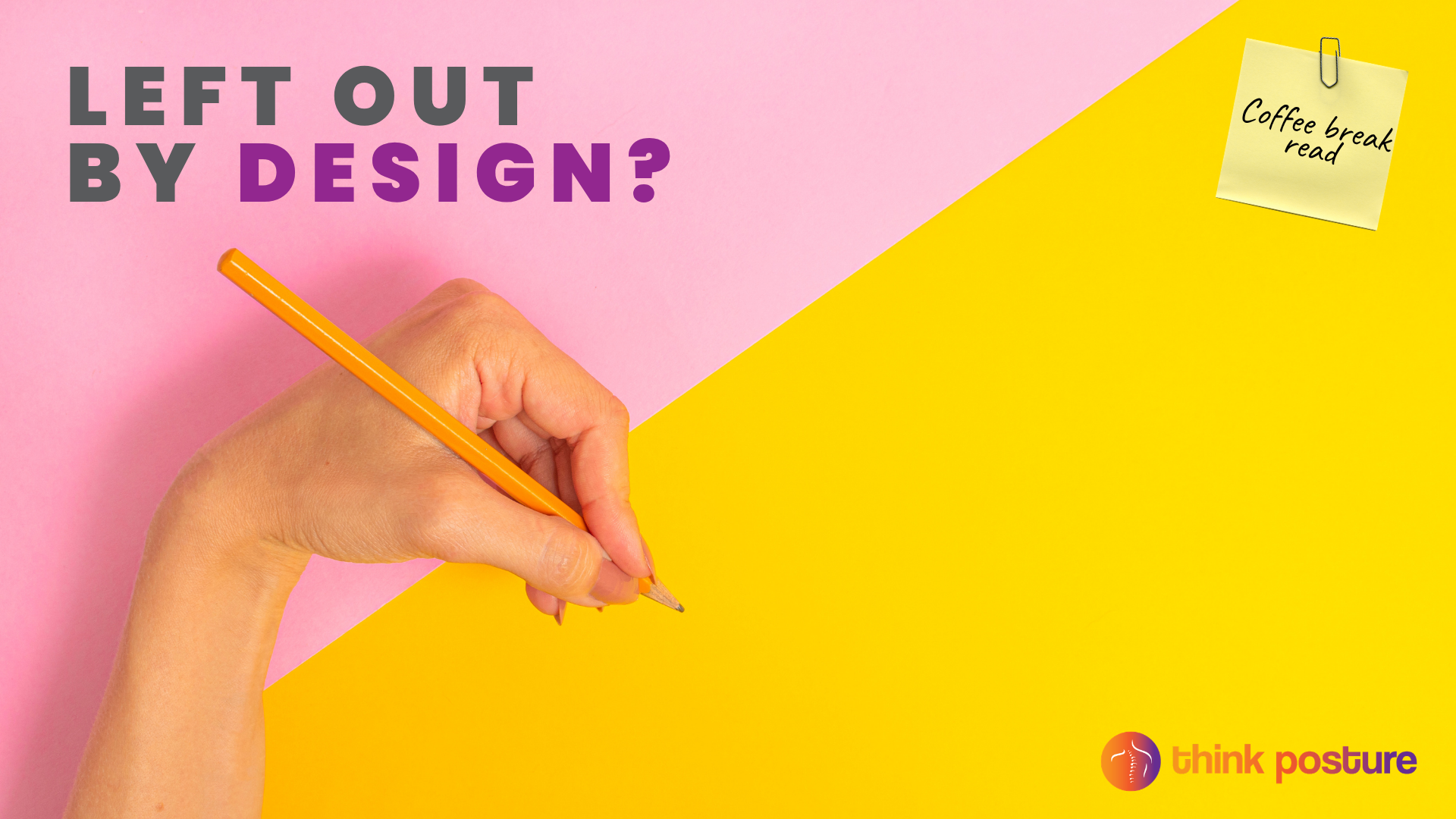
When a right-handed person writes from left to right, they pull the pen across the page. A left-handed person has to push it. Our hand follows directly behind the words, hiding what we have just written and, if we are using ink, smudging it beautifully across both the page and the side of our hand.
For many left-handers, the solution is to curl the wrist over the top of the writing line so we can see what we are doing. Problem solved. Well, apart from the bent wrist, raised elbow, rotated shoulder and slightly contorted upper body.
This is where left-handedness becomes an ergonomics issue.
When somebody cannot comfortably use the equipment in front of them, the body adapts. We lean, reach, twist, bend a wrist or lift a shoulder to complete the task. These small adjustments solve an immediate problem, but repeating them for hours, days and years can place additional demand on muscles and joints.
A small study involving left-handed students found that right-handed tablet chairs encouraged awkward postures and were associated with discomfort. When the students used an ambidextrous chair, the amount of sideways bending through the neck and lower back was reduced.
It would be impossible to say that being left-handed caused my own aches and pains. There are many factors involved. But I do wonder how many years I spent compensating for equipment that expected me to work the other way around.
What help was available then?
Some left-handed products did exist, but they were rarely part of the standard school setup.
Often, the simplest adaptations would have made the biggest difference:
- A separate table and chair, allowing both forearms to be supported
- A wider writing surface with room to position the paper correctly
- A left-handed or ambidextrous desk
- Seating a left-handed child on the left side of a shared table to prevent the inevitable elbow battle
- Demonstrating how to angle the paper and position the wrist
- Providing scissors that actually cut when held in the left hand
The biggest issue was not necessarily a complete lack of solutions. It was that many left-handed children were expected to work things out for themselves.
I certainly became very good at adapting. But adapting does not always mean working comfortably.
What is available now?
Thankfully, things have improved.
Left-handers can now find specially designed scissors, pens, rulers, notebooks, kitchen tools, keyboards and computer mice.
In schools, separate tables and chairs, ambidextrous desks, writing slopes and better guidance can help children avoid the hooked wrist and twisted upper body many of us developed.
Current occupational therapy guidance recommends positioning the paper slightly to the left and angling it clockwise. This helps the hand remain below the writing line. Holding the pen a little farther from the point can also make the writing easier to see.
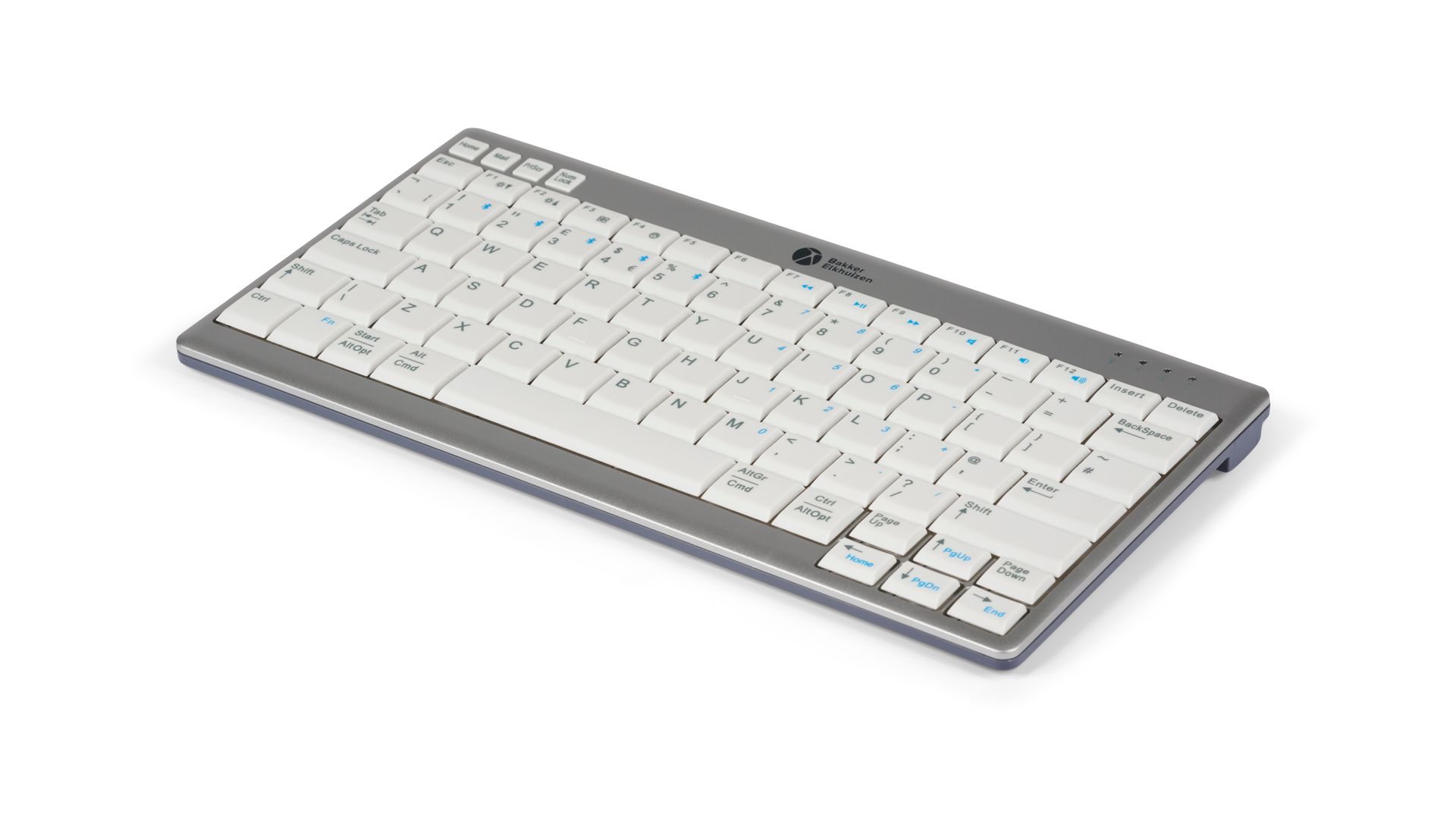
At a computer workstation, an ambidextrous or left-handed mouse can be positioned close to the left side of the keyboard. The primary mouse buttons can be switched in the computer settings, and compact keyboards can reduce unnecessary reaching.
There are even keyboards with the number pad positioned on the left for people who use one regularly. But the most important ergonomic improvement does not necessarily involve buying a specialist product. It begins with noticing how the individual naturally works and arranging their equipment around them.
A workstation assessment should consider:
- Which hand operates the mouse?
- Is the mouse close enough to the body?
- Is the forearm supported?
- Does the user lean or rotate to reach frequently used equipment?
- Are everyday items positioned on their dominant side?
- Can the workstation be rearranged to suit them?
The Health and Safety Executive warns that poorly designed workstations can contribute to discomfort in the neck, shoulders, back, arms, wrists and hands.
For a left-handed worker, an assessment needs to go beyond adjusting the chair and monitor. The position of the keyboard, mouse, phone and other frequently used equipment matters too.
Good ergonomics should not have a preferred hand
Being left-handed is not a problem that needs correcting.
The problem begins when furniture, equipment or teaching methods assume that everybody will use their body in exactly the same way.
Good ergonomics is about creating an environment that fits the individual, supports movement and removes unnecessary effort.
If someone has to twist, reach or adapt every time they use an object, perhaps it is the object that needs reconsidering. Not the person.
So, fellow left-handers, what everyday object quietly works against you?
What do you wish came in a genuinely left-handed version, and what product or adaptation has been a complete game changer?
Mine was the HSBC cheque book.
Now I am campaigning for a useful spatula and a novelty mug that allows everyone else to appreciate my excellent sense of humour.
Who’s with me?
Sources: Human Handedness meta-analysis, research into left-handed students and classroom furniture, NHS occupational therapy guidance for left-handed writers and HSE guidance on display-screen workstations.